Make ahead

Luscious pappardelle with duck and porcini ragù can happen in your very own kitchen

Pappardelle with duck and porcini ragù

There they were, on a shelf in my fridge: six duck legs.

What to do with them? I could roast them, I thought. 

But I wanted something luscious. Saucy and luscious. I wanted a braise. 

A ragù! I could make a rich, delicious duck ragù to dress big, fat, toothsome homemade pappardelle noodles. Once it got to simmering, I could make fresh pasta, working slowly and lazily as the kitchen filled with magnificent aromas. 

I hadn't made fresh pasta in years. Maybe more than a decade. But now, suddenly, I had to have it. Oh, to feel the dough gliding through the rollers of the pasta machine, then later to bite into springy, lively noodles – bathed in that luscious ragù I'd already conjured in my brain's delicious-dream center.

No turning back now. 

What did I need? What did I have? Red wine, check. Onion and carrot, check. Fresh thyme, check. Can of diced tomato, box of chicken broth, check. I even had some dried porcini, which would be perfect with the duck, rounding out and deepening the flavor. Flour and eggs for the pasta, check. 

Looked like I was in business.
 

It might sound daunting to achieve something so impressive in your own kitchen, but the duck ragù part is actually pretty easy. If you don't feel up to making your own pasta, you can still feast deliciously on duck and porcini ragù with dried pappardelle. 

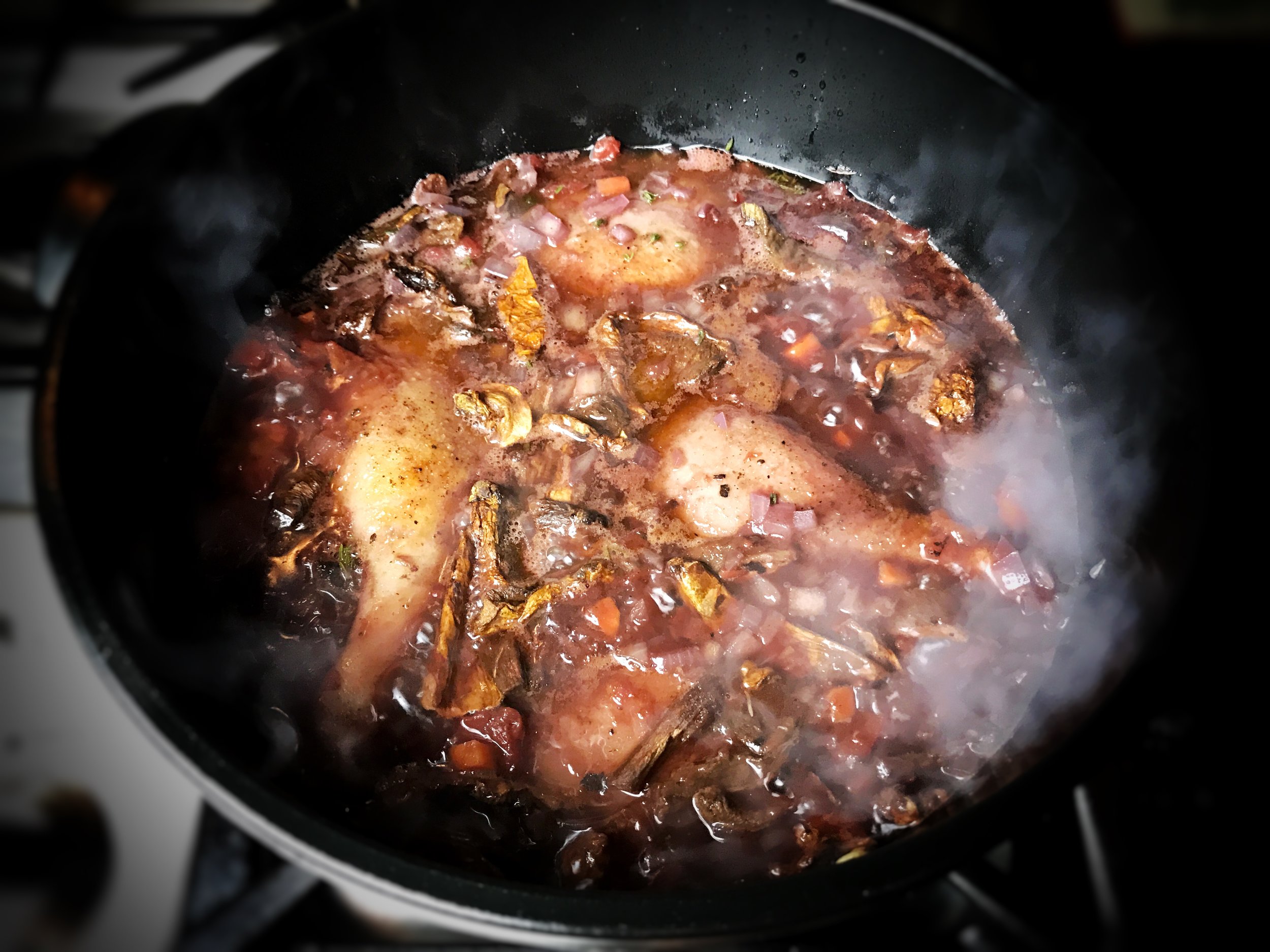
Here's how it goes. Brown the duck legs in a little olive oil, then sauté onions, diced carrot and garlic cloves. Deglaze the pan with red wine, add herbs, chicken broth, tomatoes, dried porcini and the duck legs, cover the pot partially and simmer – and simmer and simmer, low and slow. See? Nothing to it. And you're almost there.

Meanwhile, make the fresh pasta, concocted from nothing more than flour and eggs. You can make the dough in a jiff in the food processor, but lately I'm feeling low tech, so I mixed it by hand in a big bowl. (Also, my food processor blade has been recalled by Cuisinart.) It's not as difficult you might think; do it a few times, and it becomes goofy-easy. In fact, I'll reckon you can make better handmade pasta in your own kitchen than what's generally served in restaurants, where it's so often tough, or gummy.

And working with the dough – with those gorgeous aromas in the background – is supremely soothing. Even if your old-fashioned Atlas pasta machine has developed a high-pitched squeak from disuse. 
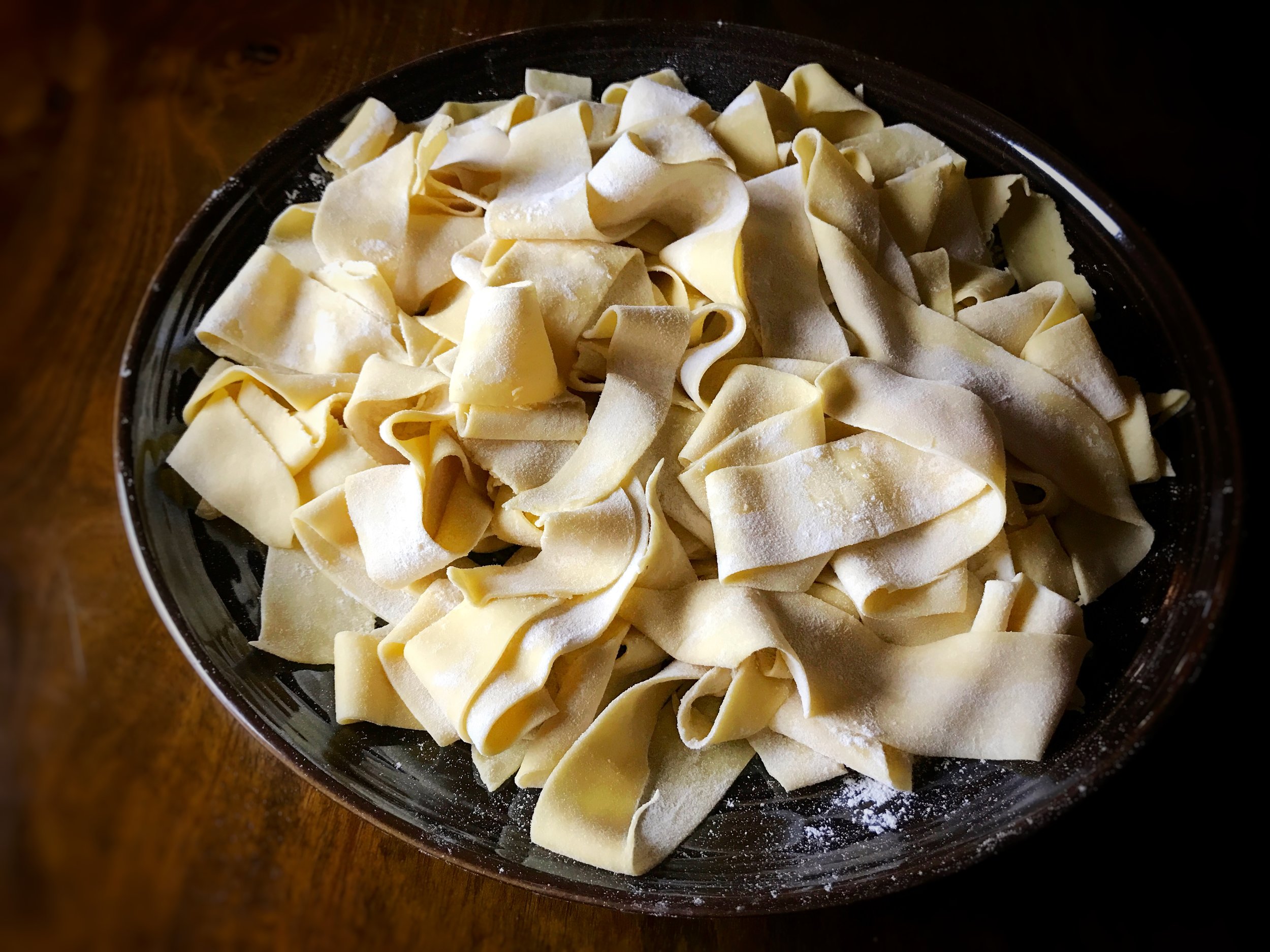
Wanna give it a whirl? Here's now to do it:

How to make awesome fresh pasta

Back to our ragù, which is now smelling insanely wonderful. When the duck legs are almost falling-off-the-bone tender, pull them out, take the meat off the bones and put all that tender meat back in. Simmer the ragù a few more minutes – basically, until you can't stand for another minute not to be eating it. Even feckless teenagers, home, say for winter break from college, won't be able to stay away.

Drop your gorgeous pasta in boiling salted water. Leave it just two or three minutes – the fresh stuff cooks really quickly. Now pull it out gently with tongs, and drop it into the simmering ragù. Let it cook there another minute, so it soaks up all that incredible flavor. Turn it into a serving bowl or platter. Drop some chopped Italian parsley on top. Or not. 
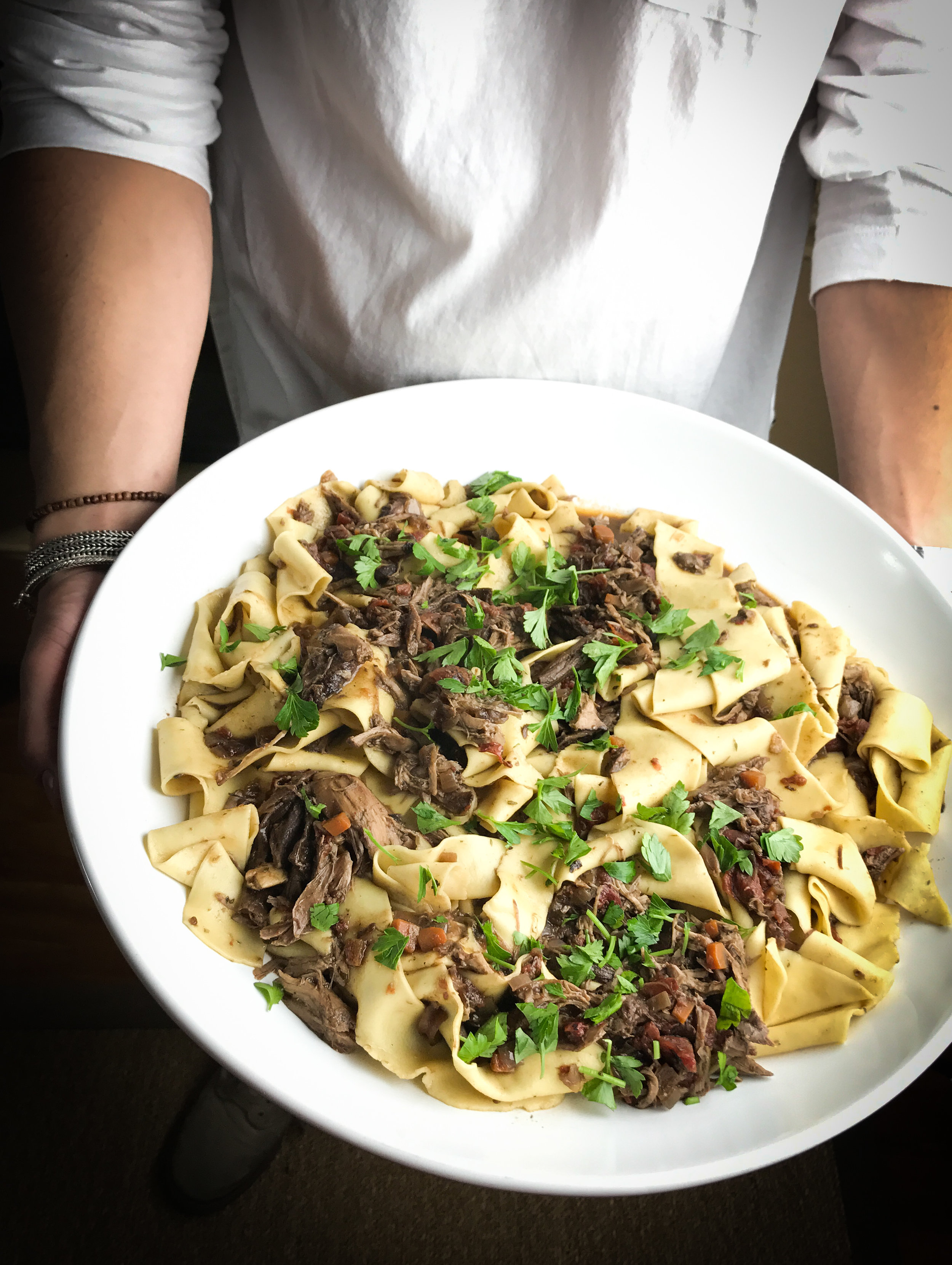
Pour the red wine. Pass the parm with a grater at the table. Prepare to swoon.

Here's the recipe. Call me when you've recovered.

RECIPE: PAPPARDELLE WITH DUCK AND PORCINI RAGù


Rich and soulful, classic beef bourguignon is the ultimate dinner party dish

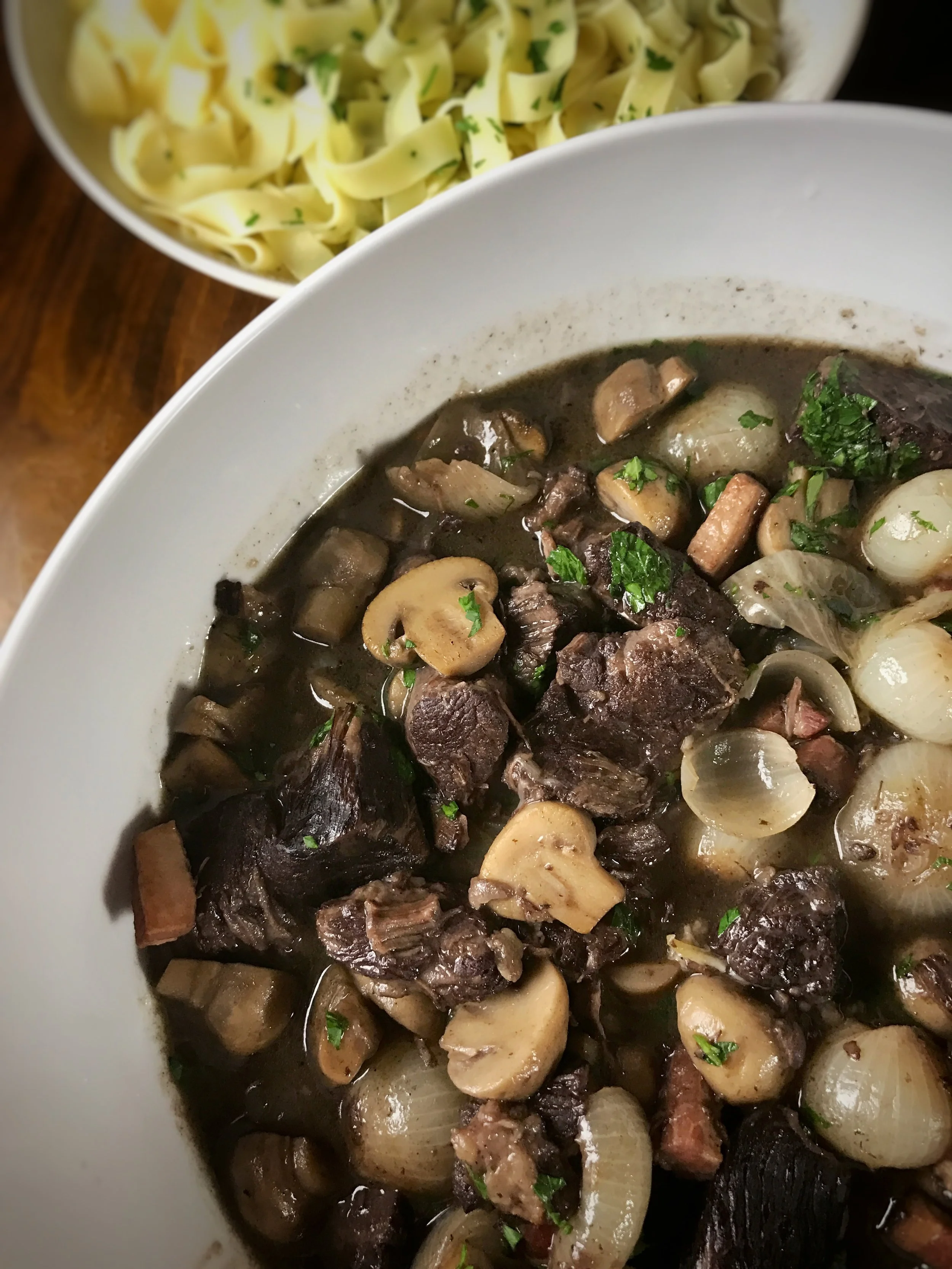
For as long as I've been a cook, I've been making boeuf bourguignon – the classic French wine-braised beef stew with mushrooms, lardons and baby onions. There's something so deeply soulful about the dish, which simmers for a couple of hours in the oven, filling the kitchen with an incredible aroma.

Those transporting scents always deliver on their promise: Beef bourguignon, a dish that coaxes maximum deliciousness from humble ingredients, is a dreamy dish to serve to friends – with good red wine and a loaf of crusty French bread for soaking up the fabulous, richly flavored sauce. It's impressive enough for any important celebration – such as New Year's Eve – or no occasion at all. Maybe it's just what you want to eat on a cold winter evening with a fire going in the fireplace. It's a dish that never shows off, but always thrills. And while it may look like a lot of steps, it's no more complicated or time-consuming than making chili.

And because you can completely make it ahead – even the day before – it's the ideal (stress-free!) dish to serve at a dinner party, along with boiled or roasted potatoes or buttered noodles.  Precede it with a wintry salad, céleri rémoulade, or, as I did this Christmas Eve, a super easy-to-make yet luxurious and velvety roasted cauliflower soup swirled with brown butter

I must have originally learned to make beef bourguignon from Julia Child's Mastering the Art of French Cooking, but over the years, I've played with the recipe, trying to answer the questions that inevitably nip at a cook's heels: What's the best cut of beef to use? What kind of wine? Should you marinate the beef or not? 

After so many years, and so many versions – abetted by a recent round of reading and more playing – I think I finally have my be-all-and-end-all version. 

Let's start with the red wine. You use a whole bottle, so you'd better use something really good, right? Well, no – happily, it doesn't much matter what you use, as long as it hasn't turned to vinegar. I never spend more than $8 or $9 dollars on the wine for this dish.

For the beef cuts, I had to abandon my beloved Julia, who calls for "lean stewing beef." Mais, non! – what you want is a fattier cut, like beef chuck, which will become super-tender as its collagens break down through its long braise. Lean stewing beef becomes hard and tough. 

From Anne Willan, author of many wonderful cookbooks and head of La Varenne cooking school in Burgundy, I gleaned the idea of using a combination of chuck and beef shank. In her fine recipe in The Country Cooking of France, Willan calls for boneless beef shank. Why not keep the bone to cook in the stew, I thought, as it (arguably) adds body and flavor? Better than throwing it away, right? I was glad I did.

I read with great interest Serious Eats' thorough story on how to make a great beef bourguignon, and pulled from it other great ideas. Author Daniel Gritzer writes about extensively testing using a marinade versus not, concluding that there's no point in marinating a long-braised dish such as this. I will gleefully accept his assays, as I've never noticed a difference in marinated verses non-marinated versions, and it's a pain to dry off the meat before browning it.

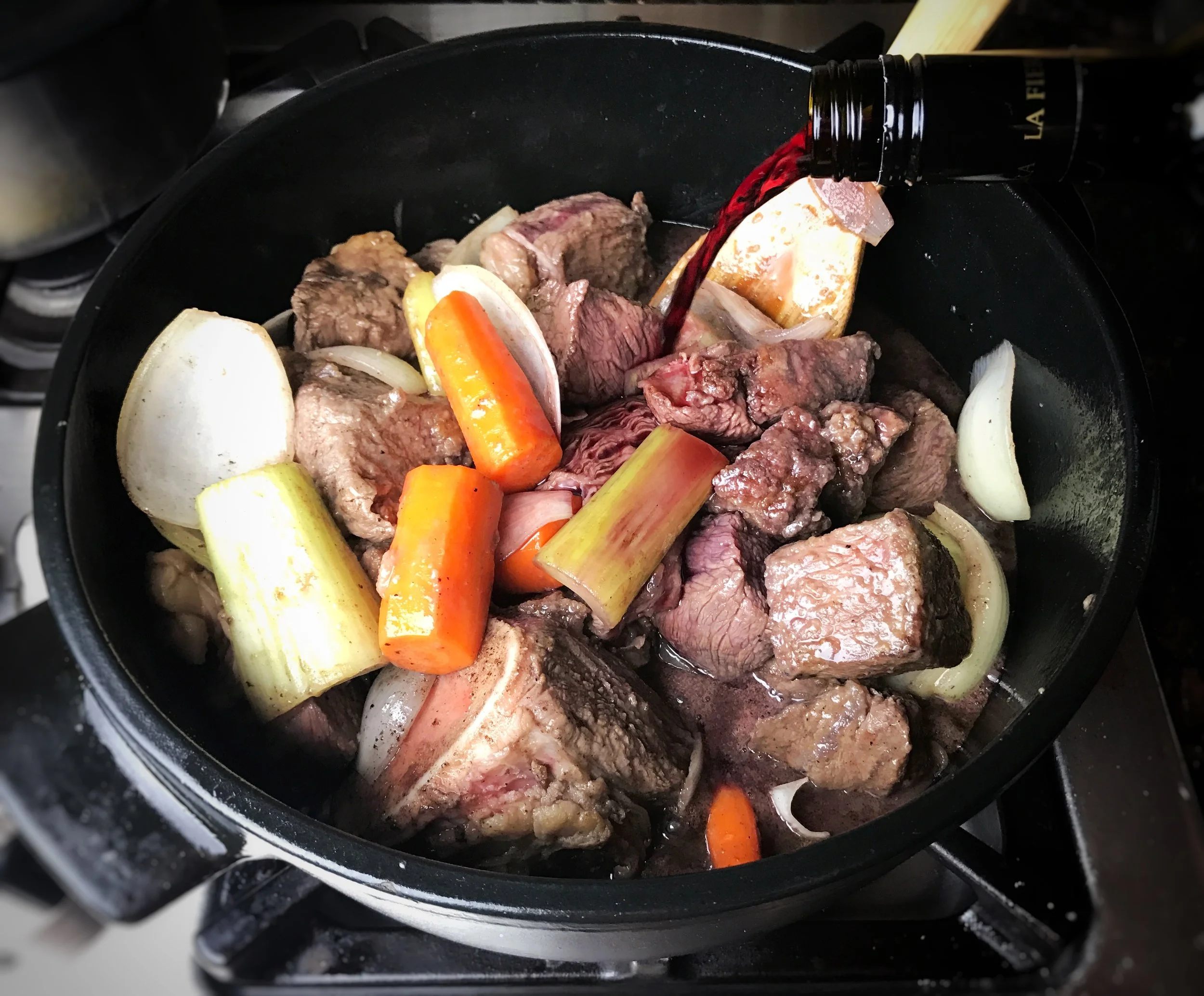
And here's something even more interesting Gritzer concludes: Browning bite-size cubes of beef dries out their surface too much. That's definitely something I've noticed over the years. His solution is to cut the meat into big slabs, and brown just two sides of the slabs, then cut up the meat. I took a different (and simplified) approach, cutting the meat into large-ish chunks (around an inch and a half is ideal), and browning just one side of the cube well, then a quick sear on another side and that's it. It's much less time-consuming (and boring) than thoroughly browning the cubes, as I used to do, and it resulted in a texture that was definitely softer and more appealing, while still getting some of the wonderful, flavor-enhancing caramelization of browning. It's a lazy man's solution that pays off! 

Yes, I know; this is a lot of bla bla bla. But it's all in the service of trying and testing and experimenting so that you (and I!) get the best possible result with the least possible effort.

Ready to cook?

Recipe: Beef Bourguignon

Here's the way it'll go, in a nutshell. Brown the meat, then lightly cook your aromatic vegetables – onion, celery and carrot – which you don't even have to dice (just cut 'em in a few pieces – another labor-saving idea I got from Serious Eats), and a little garlic. Deglaze the pan with a little wine, then add back the meat, the shank bone, the rest of the bottle of wine, a little chicken broth and a bouquet garni, bring to a simmer, then shove it in a slow oven for almost two hours, nearly unattended (just just want to stir it once or twice). Skim off the fat, discard the aromatic vegetables and bone, strain the sauce and add the meat back in, then add the garnishes you've prepared: lardons, mushrooms and baby onions, and braise another half hour.

It's more time than work, and the payoff is nothing short of awesome.


Congratulations: You have found the Brussels sprouts recipe of your dreams

It's a Brussels sprouts world; we just live in it. 

Did you hate them once upon a time? It's understandable: In olden days (like 10 years ago), people would boil those little orbs, so biting into one was like eating a small head of boiled cabbage. Ugh.

No more. Now we now that you can roast 'em or sauté them, and they're delicious. My favorite Brussels sprouts dish involves pulling off every leaf, then slicing the centers, and sautéing it all with mirepoix and pancetta. Very delicious, and very labor-intensive.

This recipe is almost as wonderful – and 9 billion times easier. It's a no-brainer. You can cook this with your eyes closed. You can make it ahead, and serve it later, reheated. Or serve it right away. Or serve it room temp. 

All you do is this. Cut the Brussels sprouts in half or quarters, depending on their size. Toss them on a baking sheet with a little olive oil and diced pancetta. You can even cheat and buy the pancetta already diced, at Trader Joe's. I won't tell anybody.  My little brother Johnny, an ex-chef, taught me that trick. If Johnny says it's okay, it's okay. 

Want to make a vegan version? Just leave out the pancetta and add about a quarter teaspoon of salt.

Roasted Brussels Sprouts with Pancetta

Roast the sprouts in a hot oven for 25 minutes. Boom, that's it. You're done. You're ready to eat – with whatever gorgeous roast or braise or take-out you've dreamed up. Vegan or not, here we come.

Be sure to drop us a comment and tell us how you liked it.

Blood orange panna cotta makes a dramatically divine (and surprisingly easy!) dessert

Blood oranges are the beach vacations of winter ingredients.

Huh? What? 

You know: It's cold out, and maybe gloomy. Maybe it's snowing. Maybe you have cabin fever. Maybe you're dreaming of stretching out on the sand on the Mayan Riviera under the sun, with crystal clear turquoise-colored water lapping at your toes. 

I'd love that, too. 

But instead, I'm going to reach for the next best thing: blood oranges. How lovely that something so juicy, so deliciously vibrant and summer-like comes into season in the dead of winter – and sticks around till May. 

A good part of their allure is visual. When they're whole, they look almost like regular oranges, but notice their slight rosacea blush. Slice one open, and it's gorgeous, its segments streaked in shades of crimson and and ruby red and blackberry. Now taste: They have a lovely flavor, sort of like oranges tinged with berry, or yes – cassis. 

In the United States, they're grown in California and Texas (two of the three states I have called home!). But I associate them with Rome, I think because once upon a time when I visited, I breakfasted on a hotel rooftop where they served crusty rolls with good butter – and glasses of fresh-squeezed blood orange juice. 

For cooks, blood oranges are a boon, as they're both delicious and dramatic. Count on them to elicit oohs and aaahs at the dinner table – especially if you spoon them over a delicately sweet, trembly-soft blood-orange-flavored panna cotta, Italy's famous custard-like dessert. 

Made from warmed, sweetened cream set with gelatin, panna cotta isn't a Roman dessert; it comes from Piedmont, according to The Oxford Companion to Italian Food, which also points out that it is "usually flavored with vanilla" (which I knew) "and peach brandy" (which I did not know). Often, the entry continues, it is served with fruit after it is unmolded, or with genuine balsamic vinegar. (Something to try! Though not with the supermarket stuff that passes for balsamic vinegar.) "It is increasingly popular with enthusiasts of the lighter side of Italian food," the 2007 book's entry concludes.

Indeed. Over the last decade, panna cotta has become a hugely popular restaurant dessert.

Happily, it is incredibly easy to make at home: In most versions, you bloom powdered gelatin over cold milk, then stir in cream that's been warmed just enough to dissolve sugar in it, cool the mixture, pour into custard cups, chill till they're set, then unmold just before serving. David Lebovitz, one of my favorite food bloggers, wrote recently, "if it takes you more than five minutes to put it together, you're taking too long!" He's not exaggerating.

Blood orange compote

Flavoring a classic panna cotta with blood orange juice gives it a delightful new dimension.  It's wonderful on its own, but top it with a compote of blood oranges and it becomes positively spectacular.  

A few thoughts about the panna cotta itself, before we get to the blood orange compote. Traditionally, it's made with cream, which makes a really rich and thick panna cotta. I like my panna cotta lighter – and more silky than velvety – so I swap out most of the cream for half-and-half. And I don't want it too stiff: soft and trembly is the idea, so I use the minimum amount of gelatin possible in order for it to hold its shape (more or less) after unmolding. (If you want yours to be a little stiffer, add an extra half a teaspoon of gelatin to the three teaspoons my recipe calls for.) 

Because it involves blood orange juice, my recipe is a little different from the traditional one: You sprinkle the gelatin over blood orange juice, let it sit, then heat it up and dissolve the sugar in the juice. Let it cool a little, then stir in the half-and-half, cream and either vanilla or orange liqueur. Pour it into custard cups (which you've lightly oiled) and let them set up in the fridge. 

While they're setting, you can make the compote; for this the only real work involved is cutting the oranges. If you're comfortable slicing suprèmes, go for it – they make a beautiful presentation. (That's what's shown above.) To do this, use a sharp paring knife to cut all the peel and pith off each orange, then slice between each membrane to release the segments, freeing them of all the membranes. With a little practice, it becomes very easy. (Here's a good walk-through on the technique from Serious Eats – scroll down to "Citrus Suprèmes" to find it.)

If you don't want to sweat it, just cut the peel and pith off the outside of each blood orange, slice it, then quarter the slices. It'll still be really pretty.

When you're slicing, be sure to capture all the juice that escapes –  you'll need half a cup for the compote. You might want to have an extra blood orange or two on hand just in case you don't capture enough juice. Heat that juice with some sugar, and cook it down till it's syrupy, then stir in a spoonful of Cognac or other brandy and pour it all over the orange segments. 

When you're ready to serve it, run a small, sharp knife around the edge of each custard cup, then invert it onto a plate or shallow bowl and let the panna cotta unmold. Sometimes you have to give it a little nudge with butter knife to release it. Divide the blood orange compote over the panna cottas and serve.

Alternately, if you don't want to unmold the panna cotta – either because it makes you nervous or you prefer a different look – you can serve the panna cotta in a wine glass or dessert glass and simply spoon some of the compote over it. 

I happen to think it's the perfect light dessert to follow a rich holiday dinner. Yes, like roast duck! Or a crown roast of pork, or a prime rib.  It's also a great finish to a lighter New Year's Eve dinner – maybe steamed lobsters, or other seafood. 

I know what you're thinking: Recipe, please! Here you go . . . 

Recipe: Blood Orange Panna Cotta with Blood Orange Compote

Meanwhile, here's some good news: Blood oranges have a nice, long season – they're usually available into May in California and Texas. So if you happen to fall in love it this dessert – or with the blood oranges themselves (they're wonderful eat out of hand, as long as you're not wearing a white tee-shirt) – this could be the beginning of a long and beautiful friendship. 


Delicious, soul-warming super-detox lentil-kale soup: Why wait till January?

It's only mid-December, and I'm already feeling like eating clean – at least in-between holiday parties and festive feasts. And here in Dallas, it's soooooo cold outside! 

What could be nicer, in such a circumstance, than the prospect of a big pot of soul-warming soup simmering on the stove? I'm thinking green lentils. And turmeric – for its strong anti-oxidant properties. And baby kale. And then a bunch of other stuff to make it delicious. 

That's what I thought yesterday morning, when it was 70 outside but I knew it was headed down to the 40s by the afternoon. 

I already had everything I needed to make the soup coming together in my head, except one key ingredient: I headed out at around 11 to pick up a cello-pack of baby kale at Trader Joe's.

By lunchtime the soup was ready – and the house filled with wonderful aromas. That's how quick and easy it is to achieve. 

The only work is chopping a few aromatic vegetables (onion, celery, carrot, garlic) and opening a can of tomatoes. (Make sure your tomatoes don't have sugar in them, or the soup won't be so detoxifying.) Sauté the veg in a little olive oil, add turmeric, coriander and herbs, then  the lentils, tomatoes and water. 

Did I mention that the recipe is vegan?

Recipe: Green lentil-baby kale detox soup

When the lentils are tender, throw in a bunch of baby kale, then let a cook a few more minutes till it all comes together. Lentils cook pretty quick, so it'll be done in just about an hour. 

Oh, baby – it turned out even better than I dreamed: lightly spiced, aromatic, earthy, soulful and satisfying. I knew Thierry would want some: Lentils are one of his favorite foods. But even Wylie (yes! He's home for winter break!) went along for the ride – that's how good it smelled. He'd just awakened at noon (college kids!) and had a bowl with us, just after his bagel and coffee. He loved it.

Here's the best part.  When I woke up this morning it was 15 degrees outside – 4 with the wind-chill factor. The tree is now decorated. We have plenty of firewood. This evening, we're going to our friends' holiday open house. 

Meanwhile, I know what I'm having for lunch.

Chicken soup is the most soothingly delicious (and supremely restorative!) thing in the world for what ails you

How are you feeling? Not so great? Yeah, I thought so. 

When someone sneezes chez moi, I reach for a chicken – to make soup. It's what my mom always did. And I've always used her recipe.

And if the husband or the son or whoever happened to sneeze isn't actually under the weather, all the better: The chicken soup idea has been planted, and I can't shake it. As the soup simmers, it fills the house with wonderful smells. Chicken soup was the fragrance of my childhood (along with Chanel No. 5, but never at the same time). And I always find diving into a big bowl of chickeny broth with carrots, celery and noodles to be supremely restorative. No one needs to be ailing for chicken soup to be a splendid idea. 

Lots of cultures celebrate chicken soup. There's Chinese wonton soup, Thai thom ka gai (with coconut and lemongrass), Mexican tortilla soup and many more. I love them all. 

Jewish penicillin

Jewish penicillin

But for Ashkenazi Jews, no matter how far-removed we are from the old country (wherever in Eastern Europe that may be), it's a primal dish, a cornerstone of Jewish culture – right up there with bagels and chopped liver. And like bagels, it's one of the few Ashkenazi dishes to have infiltrated mainstream American culture. Campbell's Chicken Soup: Is that Jewish, or American? You get my drift.

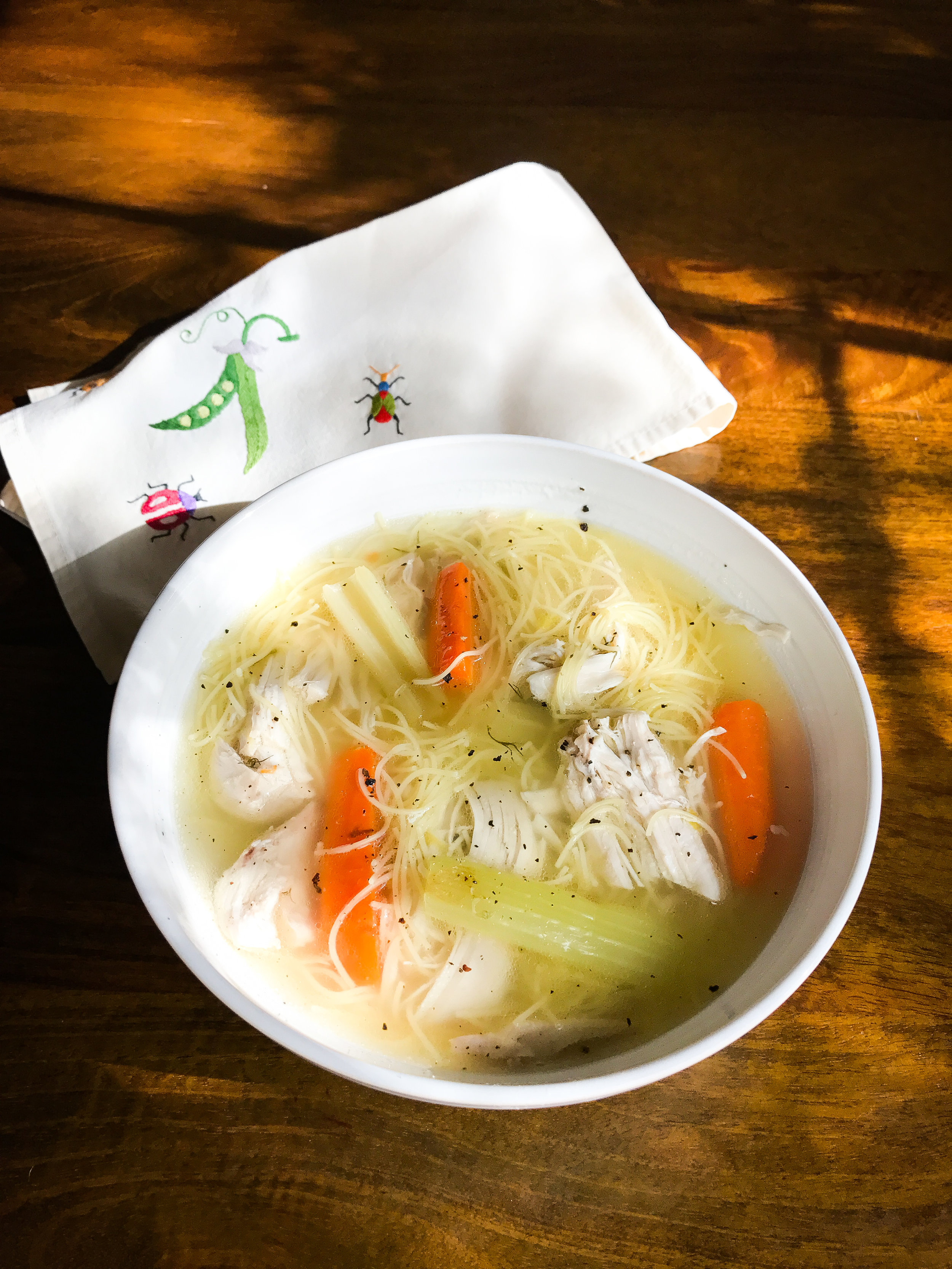
Fragrant, delicious chicken soup is very easy to make – easier, I'd say, than running out to a deli to pick some up, should you happen to be in possession of a chicken, celery and carrots. In fact, if you've never made it before, once you try it, you'll wonder why it took you so long to make your own.

It goes like this: Cut up a chicken, ask the butcher to cut one up for you or buy one already cut up. The benefit of the first two are you can keep the back and neck to put in the soup -- they add lots of richness. Cover it in cold water, bring to a simmer, and skim. Add aromatic vegetables: onion, carrot and celery. My mom always added parsnip, too, so I follow suit, but it's not essential. If you skip it, add another carrot. Throw in a bunch of dill. Let it simmer an hour and a half or two hours. 

Recipe: Joan's Chicken Soup

Add salt and pepper, and it's basically done. My mom always cooked fine egg noodles separately, put some in each bowl, and then strained some soup directly into each bowl, along with some carrots and celery. She would give us a plate of the chicken separately, and I shudder to think now that we often ate it with ketchup.

 I usually strain the whole soup –– reserving the chicken meat, carrots, celery and parsnip and adding them back into the clear soup. Put some cooked noodles in each bowl, and ladle it in.

My recipe includes measurements, but you don't have to measure things to make chicken soup; it's a soup made by feel. My mom never put garlic in hers, but I often do – especially if the soup is serving as Jewish penicillin; then I throw in a whole head, separated into cloves but not peeled. Sometimes I add a leek, or parsley. Have extra chicken parts in the freezer? Throw those in, for sure, and add a little more water. 

OK. That is my mom's gift to you. Wear it in good health. 


Turkey tetrazzini is the mac and cheese of Thanksgiving leftover dishes

You've had your fun with the turkey. Now you want the tetrazzini. 

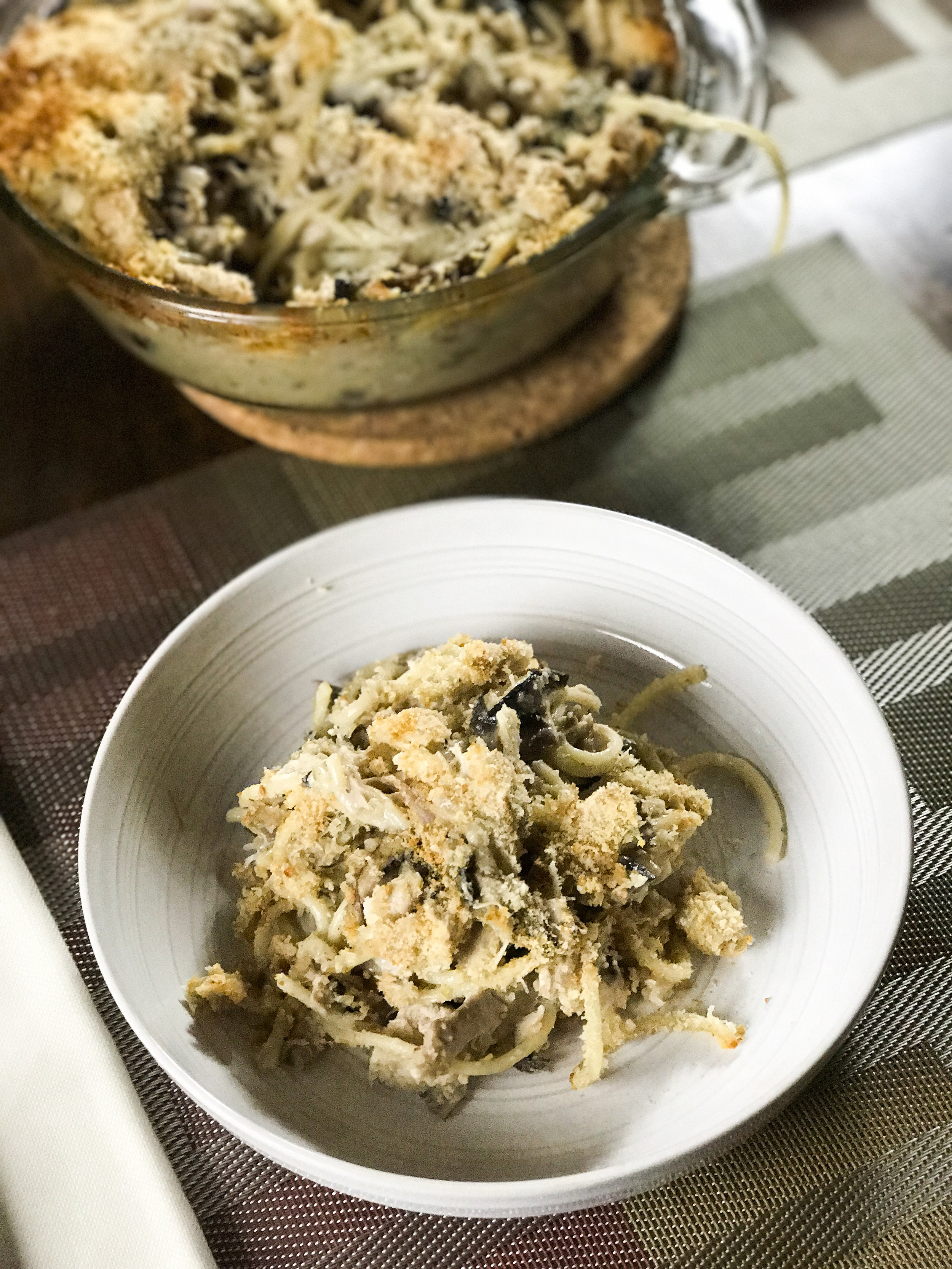
What? Never made it or even tasted it? If you love mac and cheese, this is for you – it has that some kind of old-fashioned comfort-food creamy, luscious appeal.

In fact, I always make a bigger bird than I think I'll need for Thanksgiving so I'm sure to have four cups or so of leftover turkey meat after everyone has had their fill of next-day bone-gnawing.

It's pretty simple to achieve. Boil up half a box of spaghetti. Sauté some mushrooms. Make a white sauce by sprinkling flour on the mushrooms, cooking till the flour loses its raw taste, whisking in chicken broth and milk (or a combo of milk and half-and-half, if you want it richer, or even all half-and-half), then cooking till it's thick and creamy. Stir in chopped turkey, the spaghetti, grated Parmesan cheese and seasoning and turn it into a buttered baking dish. Top with Parmesan-enriched bread crumbs and bake till the top is golden-brown.

Recipe: Turkey Tetrazzini

Then serve it up. Underneath that golden-brown, crunchy top it's rich, creamy and savory: old-fashioned comfort food at its best.

Preceded by a simple green salad and joined by a glass of full-bodied white wine, it's the perfect post-Thanksgiving dinner. 

Nervous nibbles: 5 irresistible election-night snacks

The big night is finally here! Everyone's been so swept up in prognosticating and the frenzy of voting, who's had time to think about snacks for return-watching tonight?

Since I know you already voted (right?! If not, please stop reading this now and GO VOTE!), let's project ourselves into this evening. After you vote, you can run to the supermarket.

OK, now it's six p.m. We've all snuck out of work early (after voting, of course!!!). Everyone is jittery as we gather round the TV.  Need drinks and nibbles. Your friends will bring the drinks. You can make these easy nibbles.

Amazing cheater hummus

Swipe a warm pita triangle through smooth-as-silk hummus, and you won't care who's ahead in Florida. (OK, maybe I exaggerate slightly.) It's too late to soak garbanzos overnight, so here's a super-quick and easy recipe for amazing cheater hummus, made with canned chick peas. It takes all of about ten minutes to achieve.

No one will know the chick peas used to live in a can!

RECIPE: AMAZING CHEATER HUMMUS

Sevillian marinated carrots


Whether you're looking for a vegetarian snack, or you're after a nibble the color of Donald Trump's hair, this classic tapa will spice up your evening.

Recipe: Sevillian Marinated Carrots

Charred okra

Got okra? Char it.

Got okra? Char it.

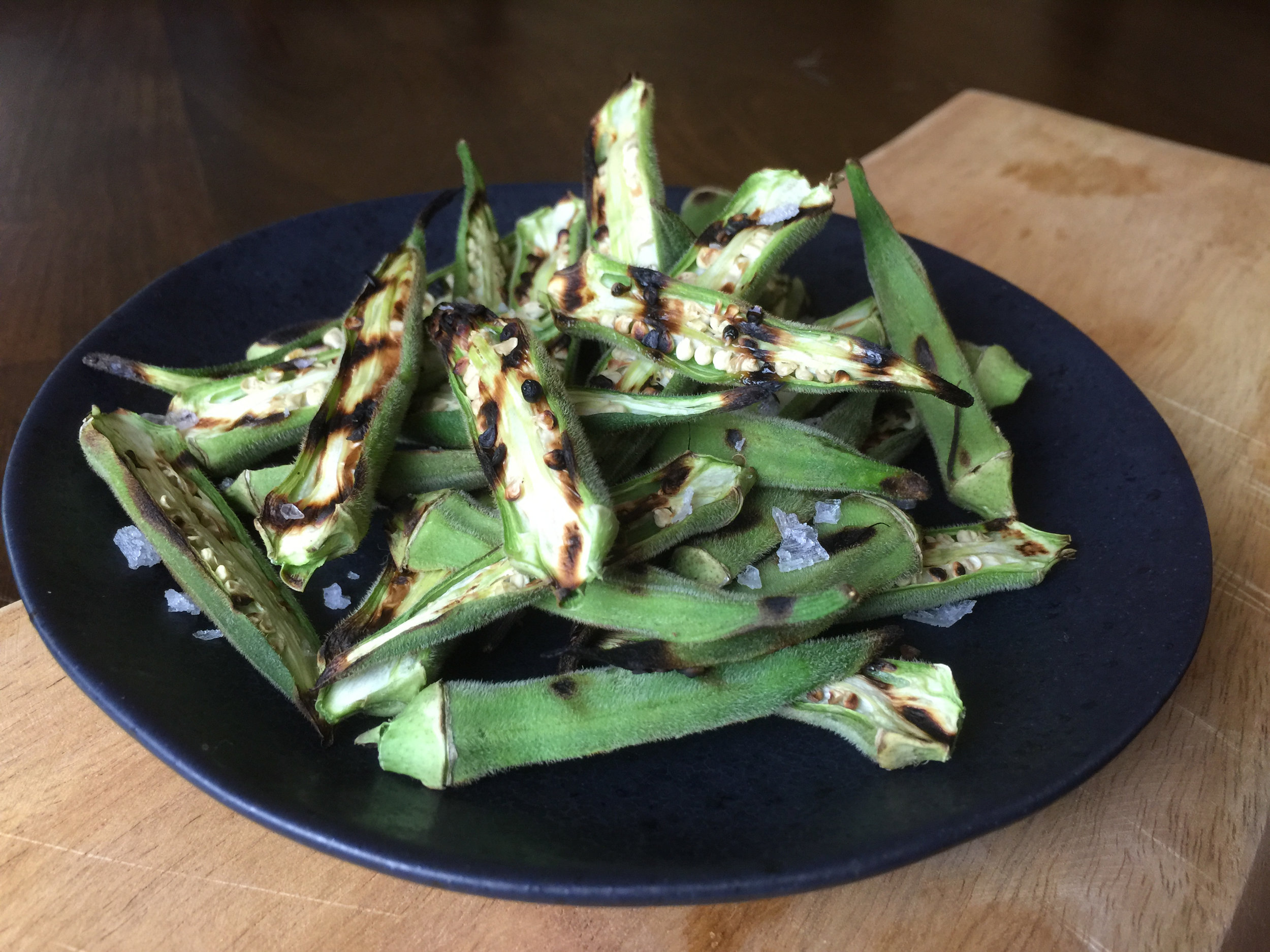
Here's another great vegetarian snack, and you don't need a recipe for this one. Procure a basket of okra, and slice each one vertically. Heat a stove-top grill (let it get really hot), brush the grill with a little olive oil, and place the okra cut-side-down on the grill. Use tongs to turn them over once they're nicely charred, and char the other side. Transfer to a platter, sprinkle with your best salt and, if you like, some kind of red pepper: Aleppo, Espellette, red chile flakes, whatever you've got. Ready, set, nibble.

Lamb meatballs

Spear these with toothpicks.

This one does double-duty: irresistible nibble and soothing comfort food. For a crowd, make a double batch. Spear 'em with toothpicks and prepare to swoon.

Recipe: Lamb Meatballs

Guacamole, salsas and chips

Our recipe for guacamole will satisfy the baddest of bad hombres; roasted salsa verde makes a great complement. Are you so nervous you can't get anything done today? Then go all-in, and make the salsa borracha, too. Don't forget the chips!

Recipe: Guacamole my way
Recipe: Roasted Salsa Verde
Recipe: Salsa Borracha

Oh, one more thing: Don't forget to VOTE!!!


Gorgeous, fabulous and ridiculously easy to make: This autumn fruit and almond cake has it all

For years I'd been meaning to cook from one of British author Diana Henry's beautiful cookbooks, like the one she won a James Beard Award for last year, A Bird in the Hand. And so when a review copy of her new book Simple: Effortless Food, Big Flavors landed in my inbox, I seized the moment. So many of the recipes look wonderful: toast with crab and cilantro-chile mayo; Indian sweet potatoes with chickpeas and coconut; roast lamb loin fillets with a minty-almondy Sicilian sauce called zhoggiu; roast eggplants with tomatoes and saffron cream.

I know, right?

But it was a sweet from her chapter on fruit desserts that I couldn't resist making right away last month – a summer fruit and almond cake. Here's what's amazing about it: You throw all the cake ingredients into the food processor, whirr them up, pour them in the pan (an 8-inch springform pan), top them with fruit (arranged "higgledy-piddledy" – how great is that?!) and pop it in the oven. Can you imagine anything easier? The recipe calls for ripe nectarines, unripe plums and raspberries; I used blackberries instead.

Summer fruit arranged "higgledy-piddledy" on top of the batter

It turned out great! Super-moist, with a nice crumb, lightly (but not overpoweringly) almondy, with just the right balance of fruit to cake. The fruit became lushly flavorful with that nice long stay in the oven. 

I would have happily made it every week or two, except for one thing: Summer ended.

Since we are now into early autumn, I thought the same almond cake featuring shoulder-season fruit – figs, plums and blackberries – could be fabulous, and Henry mentions in her headnote that you can swap out other fruit. I jumped on the occasion to feature some gorgeous ripe Mission figs I found in the supermarket, along with late-season plums and plump blackberries.

I gathered the ingredients: the usual flour, butter, eggs, sugar, baking powder, salt and vanilla, plus sour cream, almond extract, crumbled marzipan. Henry's recipe called for superfine sugar, which I can never find in the supermarket, so I tried regular sugar, which worked just fine. The fruit gets tossed in sugar too; I used less than Henry suggests, as ripe figs are sweeter than nectarines. 

I popped it in the oven and baked it, for a very long time – her recipe calls for an hour and a half, but mine took longer both times. Start testing it after an hour and a half; you know it's done when a wooden skewer inserted in the center comes out pretty clean (the fruit will mess it up a little; you just don't want raw cake batter on the skewer). Let it cool in the pan, then remove the ring and dust it with powdered sugar. (Pro tip: Put a spoonful of powdered sugar in a fine-mesh strainer, and use the spoon to tap the strainer on the side over the cake for a soft, even dusting.)

Ready to give it a spin? Here's the recipe:

Autumn Fruit and Almond Cake

And hey – I'd love to hear what you think if you try it! Or even if you don't – does it look good? Awful? Might you bake it in the future? What do you think??? We could have so much fun if y'all would leave comments!

Crazy-good classic mac and cheese may be the most craveable comfort food in the universe

You know you want it. Chefs tell me their customers demand it all the time. When I crave a rich, cheesy, creamy macaroni and cheese, I reach for the cheddar and a bag of elbow macaroni. You don't need to buy anything fancy; no bronze-die pedigree required. For this one I used supermarket large elbow macaroni, and it could not have been better. Yup, crazy-good. (Ding! Ding! Ding!)

It's simple and luxurious, and really easy to make. Boil up and drain the macaroni till al dente. Use the same pot to sweat chopped onion in butter, sprinkle on a little flour and cook it briefly. Stir in milk and cook a few minutes to make a white sauce. Stir in grated cheese, seasonings and the mac. Turn it all into a buttered baking dish, top with bread crumbs, dot the top with butter and bake in a hot oven till golden-brown.

You can riff on the recipe, adding ham or roasted chiles or crumbled bacon or whatever, but I'm a mac and cheese purist. Sharp cheddar is the cheese of choice (with a little Parm), but you can mix that up, too, throw in some Gruyère, if you're feeling French. Go ahead: Treat yourself. You deserve it. 

When I'm in the mood to indulge, a perfect dinner is a simple arugula salad, this classic, luscious mac and cheese and a glass of red wine. Right? 

Here's the recipe:

Classic Mac and Cheese

Summer's most glorious make-ahead dessert: Cardamom-scented milk custard with apricot gel and crushed pistachio

My friend Greg Stinson is one of the best cooks I know. Part of it is his impeccable taste. He also has a finely tuned instinct for what flavors will shimmer brightest right now, this second, this season. And he knows what flavors will sing together.

And so when he was shopping for a dinner whose dessert would be cool, soft cups of cardamom-scented milk custard (that much he knew) and he happened on some blushingly beautiful ripe apricots, Greg's instinct kicked in and he took the custard idea from good to great. He'd capture that wonderful fresh apricot flavor in a gel on top of the custard, one that would be soft enough to ooze saucily into the cool, lightly sweet, exotically perfumed pudding. He divined just the right garnish, too: crushed toasted pistachios. 

How lucky am I to have Greg as a friend? Lucky indeed! That dessert was the captivating finish to dinner at the home of Greg and his husband Tim Simmonds a couple weeks ago.  It began with flatbreads (handmade by Greg) topped with juicy slices of sun-warmed tomatoes from Tim's garden. Next came beautifully spiced chicken kebabs, saffron rice (with a nice bit of crunchy tadig on the bottom!) and a lovely salad of chick peas, okra, tomatoes, eggplant and onion. It was all wonderful. 

And then those custards: so cool, lightly sweet, creamy and rich (but not too), just amazing with the vibrant apricot saucy gel that tasted like a sun-drenched orchard. On top of it, they were gorgeous in their green glasses on Greg and Tim's table.

I know what you're thinking. Yes, if you're lucky you can still find apricots in the market. The dessert, which channels the flavors of Turkey or Tunisia with its cardamom scent, pistachio crunch and apricot exclamation point, is ideal for making head – perfect for a laid-back late summer dinner party. 

It took Greg a couple of tries to nail the dessert, and not surprisingly he didn't measure things or write down what he did. "But Greg!" I protested, "this could be a smashing Cooks Without Borders dessert!" He walked me through what he did and the approximate amounts he used. I took a couple stabs at home and the recipe is now ready for you:

Cardamom-scented milk custard with apricot gel and apricots

The custard – and eggless one – is easy to make, and sets up quickly in the fridge. Pour it into pretty heat-proof cups or ramekins. Then quarter the apricots – no need to peel them – and cook them down with a little sugar and fizzy prosecco till they're soft and translucent. A spin in the food processor and a trip through a fine sieve and you've got your gel to pour over the custards. Let them chill till after dinner, then top them with toasted crushed pistachios and serve. 

What can we say but three cheers for Greg?! 


Let's dive into an icy-cold bowl of spicy Korean noodles

On a hot summer evening, there's nothing more refreshing and gratifying than diving into an chilly bowl of lightly spicy Korean noodles. 

It's really like a salad and a noodle bowl tossed into one – a rare example of cold comfort food. There's shredded Romaine on the bottom, then noodles dressed with a luscious, spicy sauce, then an array of garnishes on top. Toss it all together, and eat. Want it a little spicier? Add some chile flakes. 

One nice thing about this dish is it's endlessly customizable. Use either Korean somen noodles or Japanese soba noodles. It would probably be good with glass (mung bean) noodles, too. Add or subtract toppings as you like.  Top it with a soft-boiled egg instead of a hard-boiled one. 

The dressing gets its body and spicy sweetness from raw apple and puréed kimchi. Want to make it vegetarian? Leave out the kimchi and fish sauce; use a little more soy sauce and spoonful of Korean chile paste instead. Leave off the egg as well, and it's vegan.

I'm excited for you to taste this. Please let us know how you like it!

Cold and Spicy Korean Noodles

Quick, summery bok choy-and-radish kimchi is the perfect intro to Korean cooking

Korean cooking is one of the hottest trends out there now – in more ways than one. (Yep, this food can be spicy!) Not only are chefs all over the country using Korean techniques and ingredients and riffing on Korean dishes, but Korean cookbooks are being published left and right. 

Lately I've been cooking from three new ones. Robin Ha's Cook Korean!: A Coming Book With Recipes has been making a splash (and I just finished putting up a traditional cabbage kimchi from that book). 

And there's Koreatown: A Cookbook by Deuki Hong and Matt Rodbard – I'll be testing a recipe from that one later this week. 

In the meantime, I made one dish I think you'll love – a light, summery bok choy and radish kimchi that's quick and easy to make. It's the perfect introduction to Korean cooking. And maybe the perfect introduction to Korean eating, as well – Wylie's friend Michelle, who had never tasted Korean food, loved it. 

The recipe comes from K Food: Korean Home Cooking and Street Food by Da-Hae and Gareth West, a British couple. Los Angeles Times food editor Amy Scattergood recently featured it as Cookbook of the Week. "This is the first non-traditional kimchi that Gareth and I ever made," the authors write in the headnote. "The juicy, crunchy bok choy and radishes make it feel fresh, light and summer – quite different from the typical cabbage kimchi."

Sold! I had to try it.

It's a good introduction to basic kimchi prep. First you trim, wash and brine the bok choy and radishes. The brine is just a mix of salt and sugar you toss the vegetables in, and let them sit for half an hour. Meanwhile, you make a "glue" – a spicy kimchi base you then rub all over the veg. Following the instructions as published, though, I didn't have nearly enough glue to rub all over the copious amount of bok choy, so in my adaptation, I upped the yield of the glue by fifty percent. It's a lot of bok choy when it's raw, but it shrinks way down, and you'll be happy to have lots.

Recipe: Quick Bok Choy and Radish Kimchi

Another little issue: The instructions say that you can eat it immediately, but that it's "best after it has had 3 or 4 days at room temperature to ferment," after which you can store it in the refrigerator. Unfortunately, no instructions were provided on how to do that. I will figure that out later, and let you know. 

Meanwhile, It's really good, so I wanted you to have it right away. I tasted it immediately, as soon as I was done rubbing the ingredients all over – good. Then I covered it in plastic wrap and let it sit overnight in the fridge. The next day it was really good. Refreshing, spicy, fun and yes – ideal for summer. I think you'll love it. Do let us know!


Fall in love with the most versatile warm summer salad in the universe

Are you a friend of okra? If so, you'll love this warm summer salad or summer squash, sweet cherry tomatoes, grilled corn and grilled okra. 

Are you anti-okra? You, too, will love this warm summer salad: That's because you can leave simply leave it out. Add grilled eggplant. Or some cooked black beans. Or fresh green garbanzos, if you score them at the market and you're wondering what to do with them.

I'm calling it a warm summer salad because I conceived it to be eaten warm. But it's also great at room temp. Or even straight out of the fridge the next day. 

It may be the most versatile warm salad in the universe.

It's great with cheese crumbled on – queso fresco or cotija, for a Mexican or modern Tex-Mex feel. Feta gives it a Greek accent. Shaved ricotta salata spins it Italian, especially if you make it with basil. Try cilantro, if you want to be more Mexican, or parsley for more Greek. Or mint. It's a salad without borders.


Leaving off the cheese sacrifices nothing – and makes it vegan.

It's fabulous as a starter or main course salad on its own. Serve it next to or under some grilled fish or chicken or lamb (or beef or pork or tofu . . . ) and you've got a gorgeous, cheffy main course. 

See what I mean? It's versatile. 

Don't feel like grilling the corn? Don't worry – just cut it raw off the cob and toss it in with the squash. Want to use more of one vegetable and less of another? Go ahead – it's a free country. Use balsamic or red wine vinegar in place of the sherry vinegar if you like. Throw in a handful of toasted pine nuts, or a spoonful of leftover basil. Serve it on a bed of quinoa or lentils or arugula. Or toss some arugula or microgreens on top. 

It's your salad. Now go for it.

RECIPE: WARM SUMMER SALAD WITHOUT BORDERS

How to be blown away by your own gazpacho

If you cook a lot, you've probably made gazpacho before. Maybe you've even made it dozens of times. But how often has it blown you away?

Just as I thought.

And just as we're heading into prime tomato season, it seems the right time to give the perennially popular cold soup – whose birthplace is southern Spain – a fresh look. As I wrote in a story that snagged me a James Beard Journalism Award some years ago, the soup's roots go back a long way: It was born sometime between the 7th and 13th centuries (depending on who you ask). In any case, it pretty clearly predates the arrival of tomatoes in Europe, which may come as a surprise to anyone who knows gazpacho as a cold tomato soup with cucumbers and peppers thrown in. In fact, gazpacho was originally a cold soup of pounded bread, garlic and salt with olive oil and vinegar pounded in. Some of those ingredients are often forgotten by modern American cooks, which is one of the many reasons gazpacho so often falls flat. Bread is essential for body, garlic for a little bite and vinegar for zing; a olive oil adds silkiness and its own fruity personality. 

In the summertime, when the weather's hot and tomatoes are bursting with flavor, gazpacho is one of my favorite things to make and eat. 

I approach it one of two ways. If I want a quick-as-possible version, I soak bread in sherry vinegar, toss it in the food processor with chopped tomatoes, cucumbers, a red bell pepper, a little water, garlic, salt and a pinch of red pepper, give it a whirl and serve it right away with a couple of ice cubes in the bowl. Chopped cucumber, peppers and maybe scallions go on top as garnishes. It's pretty damn good.

Gazpacho garnishes tight.jpg


But if I want a version that's absolutely stunning, I take just a couple of extra steps – peeling and seeding the tomatoes, straining the intensely-flavored juice that runs out of them and adding that to the sherry vinegar-soaking bread. I use a vegetable peeler to peel the red bell pepper. And after I purée the soup in the food processor, I give it a whirl with an immersion blender, to make it super-smooth and silky. The few minutes extra results in a gazpacho that's out-of-this-world elegant. 

A great Andalusian gazpacho depends on two things: ripe tomatoes with fabulous flavor, and the right balance of ingredients – including the vinegar and olive oil. If you get your hands on great tomatoes and use them in this recipe, I'm pretty sure you'll be blown away: 

Gazpacho Sevillano

Either way, I generally use the same or garnishes. If I make the super-smooth version, I'll take more care by dicing them finely rather then chopping them in a hurry – and sometimes add radishes and/or avocados. I can't think of a more stunning vegan summertime starter.

You can also follow the lead of chefs, and get all creative with the garnishes. Want to go super-splashy, maybe for a special dinner party? Top each bowl with a spoonful of lump crabmeat or diced cooked shrimp (or boiled tiny bay shrimp), plus some diced ripe avocado and a few pretty sprigs of frisée.

Whether you go the super-smooth route or the quicker route, I think you'll love it. Go ahead: Give it a whirl! 

 RECIPE: Gazpacho Sevillano

Summer dessert slam-dunk: Make this dazzling (and fool-proof!) stone-fruit tart

After many a summer afternoon spent pitting peaches, slicing fruit, testing crusts and going back to the drawing board, I've finally got it: a stone fruit tart that's more than just beautiful. This one has that elusive quality we're all about at Cooks Without Borders: It's crazy good.

There are definitely crusts that are quicker to put together, but this one – my go-to short crust, adapted from Lindsey Shere's Chez Panisse Desserts – is preternaturally tender and buttery. Seriously, you won't believe how great it is. Though it takes some time (you'll want to start it in the morning, or the day before), there's not a lot of work involved, it's all about resting and chilling the dough. Best of all, it's easy and fool-proof: no rolling involved; you just press it into the tart pan.

Here's how easy it is: Combine flour, salt, lemon zest and a touch of sugar. Add butter, cut into pieces, and work the butter in with your fingers till it looks like this. Sprinkle on a tablespoon of water mixed with half a teaspoon of vanilla, work that in, gather it in a ball, wrap it in plastic, and chill it half an hour.

Now flatten the ball, set it in the tart pan, and use your fingers and palms to flatten it completely and press it into the corners. Keeping flattening and pressing, moving the dough around with your palms and fingers, until it evenly covers the pan. If it seems like it won't work, or it's not enough dough, or whatever, don't worry – it will work. When you're done it will look like this. Poke some holes it with a fork (that's called "docking" the crust, so bubbles don't form under it as it bakes), cover it with foil and stick it in the freezer half an hour or overnight. 

Bake it in a 375 degree oven till it's golden brown. Let it cool slightly, and you're ready to fill it.

Recipe: Lindsey Shere's short crust tart shell

Now the real fun begins. Spoon some preserves on the bottom of the crust: peach, apricot or plum, according to your taste and the stone fruit you're using, and spread it around. Gather your stone fruit: I used nectarines, black plums and apricots for this one. Peaches are great too, of course. If you can't decide between peaches and nectarines, consider that nectarines don't have to be peeled (neither do plums or apricots). Pit then and slice them into six or eight wedges each, depending on the size of the fruit. I used medium-small nectarines, and cut them each into six wedges; same for the apricots. 

Arrange the slices, starting with the outer edge of the tart, around the periphery, skin-side down, making them stand up against the edge of the crust as vertically as you can (which may be not very). 

Make another row, using a different fruit if you like (or the same one – whatever, it's your tart!). Use that second row to nudge the first row up vertically. I used nectarines on the outside row, then plums. Then do another inside that one: I used apricots. Then another, then fill in the middle, just standing them up any which way. 

Drizzle melted butter over the fruit, sprinkle it with sugar, then sprinkle it with thyme leaves, if you like. I love that, but if you don't like the idea of herbs on your fruit, you can just leave it off – or add a different kind of depth by cooking the butter before drizzling until it's browned and nutty-tasting. A note about the sugar: I only used a tablespoon, resulting in a tart with bright fruit flavor. It was just right for me, but I wondered if it was on the tart side for others. My friends and Thierry – who has a serious sweet tooth – said it was just right for them; they wouldn't want more sugar. If you like things on the sweeter side, use 1 1/2 or 2 tablespoons.

Recipe: stone-fruit tart with thyme

Into the oven it goes; half an hour later it comes out.

Pretty, ain't she? You can serve it a little warm, or completely cooled; it's great for entertaining, as you can make it in the morning, if you like, and let it sit all day. Serve it just like that, naked, or with a scoop of vanilla ice cream, or maybe a dollop of lightly sweetened crème fraîche.

Happy summer.


Did someone say 'butterflied leg of lamb'? Fire up the grill for a dreamy Mediterranean dinner

Border-free cooks, this may be the perfect summer dinner – especially if you're in the mood for Mediterranean flavors. Grilled butterflied leg of lamb, with asparagus spears thrown over the coals at the same time. A couple of fabulous salads to start, from the James Beard Award-winning cookbook Zahav: A World of Israeli Cooking. A gorgeous tart to make the most of sweet-and-ripe summer stone fruit. 

It's ideal for laid-back entertaining (eat outside!) as nearly everything can be done ahead. 

Friends were coming over last night, and I knew we'd want to relax and hang out, maybe have some nibbles before dinner and a glass or three of rosé before I lighted the charcoal on my old-fashioned Weber. A butterflied leg of lamb on the grill sounded about the right speed; I've been craving summer's char. 

Flipping through Zahav, I happened upon a couple of salads that spoke to me.

The first was quinoa, pea and mint tabbouleh. Irresistible, right? So smart of chef Michael Solomonov (who wrote the book with Steven Cook) to swap quinoa for the traditional bulgur wheat, and toss in peas to play with the mint. No need to use fresh peas when frozen ones (so stress-free) do just fine. 

The dish was as wonderful as I'd hoped – and then some.  I'm going to make it again, pronto. The recipe serves 4 to 6, but next time I'll probably double it so I have some left over for the next day. So good! I can't wait for you to try it and tell me what you think.

Recipe: Quinoa, pea and mint tabbouleh

I served that as a first course before the lamb, but first we had nibbles: some marinated gigante beans I found at the olive bar at Whole Foods (speared with toothpicks – crazy, right?); spicy pickled okra (also from the olive bar); roasted salted cashews; and Castelvetrano olives (my faves).

But the star nibble was charred eggplant salad from the Zahav cookbook. To make it, you char halved eggplants on a grill or stovetop grill – I used the cast-iron grill that fits right on my stovetop – cut-side down, until the flesh is "like pudding" in texture. It took a long time – about 45 minutes. Alternatively, you can do it under a broiler (cut-side up). Scoop out the flesh (discarding the charred exterior), and use a spoon to beat it to creaminess with minced raw garlic and olive oil; then you stir in salt. The recipe called for topping it with half a cup of chopped fresh parsley, but that turned out to be too much; I cut it down to a quarter cup, stirring half of it into the salad and using the rest as garnish on top – just right.

It was pretty delicious – the proportions were otherwise perfect – and I served it with triangles of whole-wheat pita bread toasted in the oven. I felt it would be even better with a zing of acid, so I squeeze in half a lemon, and it went from delicious to dreamy. 

Recipe: Charred eggplant salad

If you own the cookbook, you might notice that the photo with the eggplant salad recipe is more reddish in color than mine turned out, flecked with something that looks like small bits of roasted red pepper or tomato. Hmmm. Very intriguing. There is a variation offered: adding a cup of tehina sauce turns the salad into baba ganoush (eager to try!). But no other variation is mentioned. It seems like a recipe ripe for improvisation. 

The timing on this dinner is very easy, as you can made the eggplant salad, tabbouleh and dessert in advance, letting the lamb bask lazily in its marinade (olive oil, red wine vinegar, crushed garlic, chopped mint and cilantro, salt and pepper). Rather than keeping the lamb tied up after it's bones have been removed, you unroll it so it's flattish – that way it absorbs more marinade, cooks more quickly and gets more charred surface. The marinade, meanwhile, is one you can play with, depending on the flavors you want – maybe rosemary and/or thyme instead of mint and cilantro, or more or less garlic, maybe Aleppo pepper or cayenne rather than black pepper. You get the idea. You can marinate it for a couple of hours, or overnight.

Once you're ready to grill and the coals are hot, wipe the marinade off the meat (be sure to bring the meat to room temp for about an hour first) and spread the lamb flat on the grill. Toss some asparagus spears in a little olive oil and salt and throw them on the grill next to the lamb after the lamb has been on there two or three minutes. Keep the grill covered to prevent flare-ups, and flip the meat after 6 or 8 minutes. You'll want to keep an eye on, as it the cooking time can range from 12 to about 22 minutes total depending on how hot the coals are, the size of the cut and how done you like it. If you're going for medium-rare, aim for an internal temperature of about 130. But don't worry if it goes past that – even if it's done to medium it's really good. 

Got it? Here's the recipe:

Grilled butterflied leg of lamb

Once it's done, be sure to let it rest for at least 10 minutes, so it's as juicy and tender as can be. Go ahead and serve the tabbouleh as a first course (or whatever you've dreamed up – the tabbouleh is also really good with the lamb!). By the time you're done, the lamb will have rested long enough. Slice it (across the grain), laying the slices on a platter and pouring over them any juices that have collected on the plate as it rested.  Oh, man – you are in for a treat! Serve it with the asparagus. If you're tired of asparagus, you could just as well have done zucchinis quartered lengthwise on the grill – that would be great with it, too.

Stone fruit tart with thyme

"We should have started with this!" That's usually Thierry's refrain come dessert-time; he has a sweet tooth. I was really, really happy with the way this tart – which starred nectarines, black plums and apricots – turned out.

OK. I'm not going to go on and on about the tart; instead I'll tell you more about it in a separate post. For now, here's the recipe:

Recipe: Stone-fruit tart with thyme

Thrill of the chill: Poached arctic char with dill sauce tastes like summer in Scandinavia

Oh, wait – it's not summer yet? It's certainly heating up! And when the going gets hot, Scandinavian-style cold poached salmon makes a delicious centerpiece for a dreamy chilled dinner or lunch.

Traditionally, this is done with a whole salmon – and that's fantastic for feeding a crowd. But what if you just want to do a salmon fillet? What if it's just dinner for two? Or what if you go to the fish counter and beautiful arctic char fillets are on sale? 

Grab that fillet and get ready to poach. It's so easy and yield such great results that if you've never done it before, you'll wonder where the technique has been all your life.


Lay the fillet skin-side down in a smallish roasting pan (or a fish poacher, if you happen to have one, which I don't). Cover it with cold water and add enough salt to make it taste like the sea. You don't need to add other flavorings to the water, as the both char and salmon have enough lovely flavor on their own; char's flavor is a little more delicate. Bring the water to a simmer, turn off the heat and let the fish sit in the hot water for 25 minutes. Transfer it to a platter and chill it. That's it. Garnish it with slices of lemon and sprigs of dill, if you like. 

You probably don't even need a recipe, but here it is:

Recipe: Cold poached arctic char

A 1 1/4 pound fillet serves two or three; poach two fillets if you want to serve four to six. 

Serve it with a mustardy fresh dill sauce, and asparagus and boiled red potatoes – both are which delicious if they happen to crash into that dill sauce. I nearly forgot: cold cucumber salad's great with it, too!

Here's how to make the cucumber salad: 

Recipe: cucumber-dill salad

And the dill sauce . . . 

Recipe: Dill sauce

And here's the best part. Make the fish and the dill sauce (and cucumber salad, if you're doing that...) in the morning, or the day before. Then you just pull 'em out of the fridge and serve. How's that for chill?


Say hello to a super easy (and crazy good!) berry and peach crisp

In case you haven't noticed, I love love love fruit desserts.

A few days ago I found myself in possession of a fridge drawer full of ripe peaches – placed in chilly purgatory against my better instincts. I get so excited during the season that I overbuy (how is it possible that I'm the only one in the house who snacks on them?), and in Texas almost-summer, they go from ripe to fuggedaboudit in no time flat. So into the fridge they went . . . and joined an embarrassment of blackberries and raspberries. 

Peaches . . . blackberries . . . raspberries . . . hey, wait a minute. Sounds like a crisp just waiting to happen! 

The simple topping on this one, inspired by one I've made a million times from Lindsey Shere's Chez Panisse Desserts, is something every fruit-dessert-lover should have in his or her repertoire. Nothing more than flour, brown and white sugar, salt and a pinch of cinnamon with some slightly softened butter worked in with your fingers and toasted almond slivers added at the end, it puts just the right not-too-sweet crunch on top of luscious fruit. Years ago something gave me the idea (David Lebovitz's blog maybe?) that you can double the amount of crisp and freeze half of it, so if a windfall of ripe peaches or nectarines comes your way, you can quickly achieve a repeat performance. Brilliant.

So, what to do with the fruit? Peel and pit the peaches (about two pounds) and slice 'em into a bowl. Rinse a few baskets of berries (blackberries, or a combo of blackberries and raspberries) and add them to the peaches. Sprinkle a tablespoon of flour and two tablespoons of sugar on the fruit, toss it gently, and turn it into a baking dish. Smooth out the top a little, then distribute the topping over all. Pop it in an 375 degree oven for about 35 minutes, et voilà. The juices, peach and berry wonderfulness mingled together – concentrated and syrupy – bubble up through the crust here and there as it bakes.

Sometimes I serve it warm with vanilla ice cream. Sometimes I whisk some crème fraîche into whipped cream and serve it with a dollop of that. This time I just made good old fashioned whipped cream (lightly sweetened, with a glug of vanilla) and plopped that on each slice.

It was so good, all that juicy fruit bursting with flavor topped by that miraculous layer of brown and buttery crispness, that we nearly wept. 

No one stopped at one piece.

Perhaps you'd like the recipe?

Recipe: berry and peach crisp


Celebrated Dallas restaurateur Monica Greene shares a favorite dish from her Mexico City childhood: ropa vieja

Monica Greene in the Cooks Without Borders kitchen 

Most Texans see a brisket and think: barbecue. Monica Greene, the legendary Dallas restaurateur, sees a brisket and thinks: ropa vieja.

Everyone in town knows Monica, who visited Cooks Without Borders headquarters (my kitchen!) recently as an honored guest cook. She's no longer in the business; her last (and short-lived) restaurant – Monica's Nueva Cocina – closed in 2012.  Nevertheless, her impact on Dallas' vibrant modern Mexican cooking culture is undeniable and indelible. A pioneer of the movement, she and chef Joanne Bondy introduced the city to dishes like cabrito tacos with apple-plum butter and veal shortribs braised in mole rojo when they opened their ground-breaking restaurant Ciudad in 2000. Her long-running Deep Ellum place Monica's Aca y Alla introduced a generation of Dallasites to the joys of Mexican eating.

What her fans might not know is that Monica, who grew up in Mexico City, also loves to cook.

"Cooking is my favorite thing in the world," she tells me as she slices onions, chops carrots and celery, fills my giant stockpot with water. She's here to make ropa vieja, a shredded cold beef salad that evokes her Mexico City childhood. 

Warm and gregarious as she is, she established her reputation as the face of her restaurants, running dining rooms. "From the very beginning, people told me 'you stay up front.' So when I opened my restaurant, I was a door person. But whenever I had a chance, I'd go work in the kitchen."

The first order of business is getting the brisket trimmed and simmering: It will need nearly three hours to cook to tenderness. Once Monica cuts it in half and drops it into the stockpot of simmering onions, carrots, celery, garlic, herbs and cumin seeds, we take our time and put together all the components of the salad. And yes, we talk – and talk and talk.

She tells me about her childhood in Mexico City, where she was the seventh of eight children: four boys and four girls. Their mother died when she was three, but she has fond memories of gathering with her siblings every evening around the big butcher block in the center of the family kitchen, where their cook would prepare dinner. All eight kids, and inevitably their friends as well.

"Every once in a while," she says, "you got to choose what we had. I wanted to eat two dishes. One was a chicken breast wrapped in an apple. I've never seen it anywhere else in my entire life. You boil the apple to take off the skin, wrap a pounded chicken breast around it and roast it. The other was ropa vieja." 

The dish, which translates as "old clothes,"takes a different form than the well-known Cuban version, in which the braised shredded beef is served warm, like a stew. Monica's Mexico City iteration is a cold salad.  "In the north, they pan-sear and brown and seal the meat, then put it in the oven." In the south, you boil it; the beef serves as a vehicle to the other flavors: pickled onions and tomatoes and avocado and cilantro. "It’s more of a symphony."

Monica slices nopal – a cactus paddle – before boiling it.

She talks, too, over the course of an afternoon – the kind of lazy, cooking afternoon I love – about some of the challenges she has faced in her life. How hard it was to find a job after making the transition from Eduardo Greene more than 20 years ago to Monica Greene, at a time when people didn't know what to make of such an evolution. At that point she had become a beautiful woman (she shows me photos on her phone) and she felt like a woman, but the way she looked and felt didn't match the name on her drivers' license or social security card. 

Now she's reinventing herself once again, taking time off to travel – she has just returned from Mexico (where she reconnected with one of her brothers) and then Bali. She's in Dallas for a week, spending as much time as possible with her grandchildren, and then she's off to her second home, in Aspen, Colorado for a month – or five.  "I realized I'd been working 41 years," she says, "and I wanted to take a sabbatical and pursue my passions. I have to travel – before there's a time I cannot walk up the pyramid." 

She's also writing. "I took a couple of classes at the Aspen Writers Foundation," she tells me. "They were workshops, basically. And I found I have a lot of passion for it." One project is a Mexican cookbook. "I've been working on it for two years." She's also working on a children's book ("I'm an illustrator also") and a book of fiction. "It's partly the story of my life," she says. "I think when most writers write fiction, they're writing about themselves."

Between anecdotes and bons mots, memories of her aging father succumbing to Alzheimer's and a fabulous reunion with a cherished brother, everything starts to come together for the salad. Rounds of purple-edged Bermuda onions turn to tangy pickles, perfumed with allspice and kicked with habanero chile.  A cactus paddle is declawed, sliced, boiled till it taste like desert green beans. Eggs are boiled ("We're going to overcook them a little," she says, "because we're going to do the yolks in powder and the whites in strips.") Lime juice, jalapeño, vinegar, oil and a whole lot of cilantro get whirred up into a dressing that will pull all the flavors together. Rosé is poured, with predictions of tequila flowing in the near future.

"I don't use technique," she says; "I use tradition." Still, it's fun watching her slice Roma tomatoes, using her knife to liberate their hearts full of sees and coax them into flat obedience on the cutting board, ready to be sliced into even strips. "Yes, I can cut fast, but that's like making love too fast."

 Monica pushes the egg yolks through a strainer, crumbles queso fresco, as I slice avocados to her specs. Neighbors show up, hungry and excited. Monica tosses the ropa vieja, then arranges it on a platter. 

It's got everything: richness, depth, wonderful tang, the prodigious perfume of cilantro. You can serve it just like that, Monica says, or spoon some onto round, fried tostadas for some crunch. 

Dinner is just as relaxed as the cooking was. "It's even better with tequila," Monica suggests, and wow! She has brought a bottle of Casa Dragones. Out come the shot glasses, but this is special, for sipping.

She's right. Tequila and ropa vieja is a match made in heaven. 

Her gift to you: This recipe. Hope for leftovers, but don't expect them.

Monica Greene's Ropa Vieja